Get started in the Bluebeam Developer Portal
The Bluebeam Developer Portal has been rebuilt to give developers a faster and clearer self-service experience. This guide walks through the new Sandbox environment, streamlined app registration flow, in-browser API testing, and new Production approval process.
To get started, review the How to get started overview.
Choose your path:
-
New to Bluebeam's API? Head down to Platform overview.
-
To get started, create a new Client Application.
What's new
-
Automated onboarding: Access is granted instantly at login based on your subscription.
-
Sandbox-first workflow: All apps start in Sandbox, giving you a safe space to build and test before going live.
-
Simplified app creation: The new "Create Application" form displays only the fields that apply to Bluebeam integrations.
-
In-browser API testing: The new "Test Request" feature lets you execute calls directly in the docs, in multiple languages.
-
Endpoint search: Search across all API endpoints and parameters without scrolling.
-
Markups API endpoints: These endpoints are now out of Beta and available to all developers.
How to get started overview
Step1: Log in
Go to developers.bluebeam.com and sign in with your BBID. Access is granted automatically with an active Core, Complete, or Max plan. Go to Step 1 ➝
Step 2: Build and test in Sandbox
Use your Sandbox credentials to build and test before your integration reaches end users. Go to Step 2 ➝
Step 3: Create Application
Go to My Apps and select Create Application. Provide the application name, description, region, and redirect URI(s). Go to Step 3 ➝
Step 4: View the My Apps dashboard
The My Apps table has been updated with additional columns so you can see key app details at a glance. Go to Step 4 ➝
Step 5: Review API documentation and Test Request
Use Test Request in the API docs to validate endpoint behavior in-browser. Go to Step 5 ➝
Step 6: Request Production Approval
From your app's detail page, select Request Production Approval and submit the Request Production Approval Form. Go to Step 6 ➝
Step 7: Go live
The Bluebeam integrations team reviews and follows up. Once approved, your app is promoted to Production.
 Platform overview
The Bluebeam API is RESTful and currently has 2 categories of endpoints:
-
Authentication
-
Studio
There are region-specific base URLs that apply to all endpoints:
For example, https://api.bluebeam.com/publicapi/v1/sessions in the US would be https://api.bluebeamstudio.com.au/publicapi/v1/sessions in AU.
Authentication
Some high-level notes of how we handle authentication:
-
Authentication with OAuth 2.0
-
All API calls are made under the context of a user. By authenticating with OAuth, a user grants permission to your App to gain access to their data and make API requests on their behalf.
-
-
All requests and response bodies must be JSON formatted. Set the Content-Type: application/json header on all requests that have bodies.
-
API calls must be made over HTTPS.
-
See our Authentication Guide to start setting up OAuth 2.0 in your App.
Studio
Studio is our cloud collaboration platform with a direct connection to our flagship desktop application: Bluebeam Revu. Our Studio endpoints open up lines of communication for seamless integration between Studio and your systems.
You can generally think about the functionality offered by the Studio API as the same set of functionality that a user would get via the Studio GUI in Revu.
To learn more about Studio, visit our Studio FAQ page.
Create a new Client Application
To get an access token, follow these steps:
Step 1: Access & authentication
When you log in with your BBID credentials via Okta, the portal instantly verifies your eligibility. There is no manual onboarding request or email to the Partnerships team required unless you are a Software developer and/or partner.
Subscription requirements
At login, the portal checks that your account meets all three criteria:
-
Valid BBID account
-
Active Core, Complete, or Max subscription
-
Basics plan not eligible: Basics subscribers cannot access the Developer Portal because they cannot create Projects and Sessions, which are critical operations for most integrations. Upgrade to Core, Complete, or Max to gain access.
-
Software developers and partners: If you need a special NFR license through Bluebeam Partnerships, you will need to request access to the Bluebeam Developer Portal.
-
-
Eligible region: US, AU, DE, UK, and SE
Step 2: Sandbox environment
All new apps are created in the Sandbox environment by default. Sandbox gives you a dedicated space to build and test your integration safely before it reaches end users.
-
Sandbox credentials will remain consistent as your app is moved to Production.
-
When promoting to Production, rate limits will adjust to support real-world usage constraints.
-
While your app is in Sandbox, only the account that owns the application can authenticate through the app. Other users will be able to use the app after it is moved to Production.
-
Apps remain in Sandbox until you explicitly request Production approval (see Step 6).
Step 3: Create your application
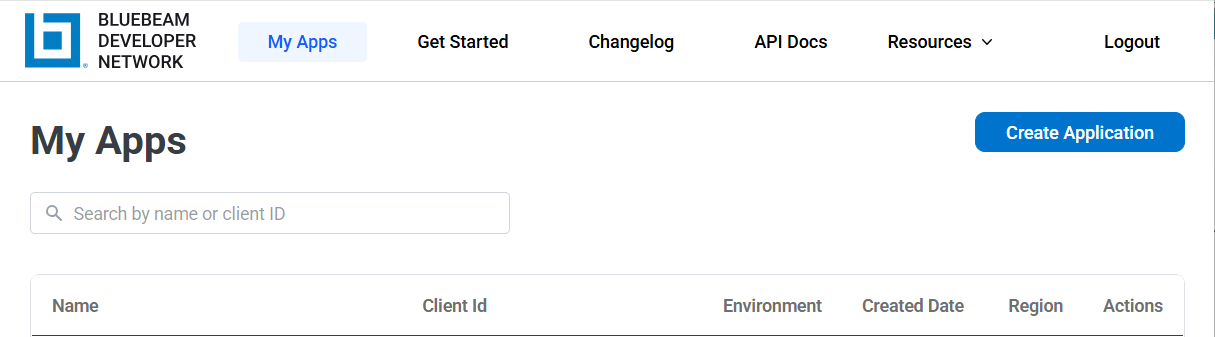
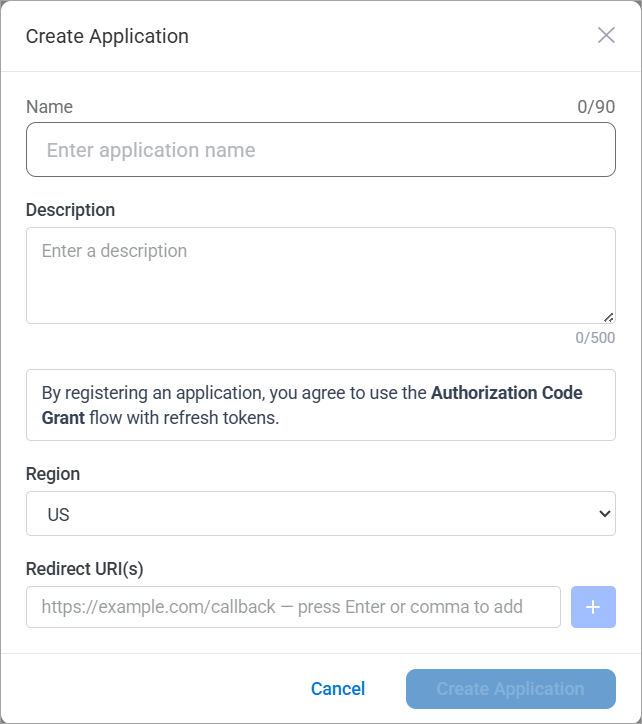
The app creation flow has been redesigned. The Create Application form shows only the fields relevant to Bluebeam integrations.
Platform & regions
-
Go to My Apps and select Create Application.
-
Select the API instance that matches your region when creating your application:
Registration Form fields
-
Fill out the Registration Form fields:
-
Application name: Enter up to 90 characters.
-
Description: Enter up to 300 characters.
-
Region: Select the Bluebeam API instance for your region.
-
Redirect URL(s): Enter comma-separated values or press Enter–the portal organizes them in a paginated list.
-
Testing with Postman? For Redirect URI, use https://oauth.pstmn.io/v1/callback. Your production app will use a different URI.
-
Authentication notes
-
Bluebeam API supports only the following selections for Grant Type:
-
Authorization Code: All API calls use OAuth 2.0; users grant your app permission to act on their behalf
-
Refresh Token
-
-
Redirect URI: Use https://oauth.pstmn.io/v1/callback
This URI is specific to making calls in Postman. Alternate API tools or your App will require a different URI. -
Select Create Application to submit the form.
Upon submitting the form, you'll receive a MuleSoft branded email with the subject: "Application registration approved“. Please ignore the ignore the email. It's an unwanted side-effect of using our out-of-the-box solution. -
Get credentials. Now you should see your newly created App in the list (if you don't see it, refresh your browser). Click anywhere on the app line, and it will open the details page where you can view your Client ID and Client Secret.

-
If using Postman for testing, get an access token via Postman.
-
Access Postman via their desktop app or browser and create a free account.
-
Here's a script that you can import into Postman. This script is a collection of all available Bluebeam API calls. In Postman, go to File > Import, and drop the script in.
-
To get an
access_tokenin Postman, select the Bluebeam API (Script x.x.x) collection. -
Select the Authorization tab to configure a new token in Postman.
For more information regarding authentication, see the Authentication Guide. The Authentication Guide references request parameters; these are known as variables in Postman.You can either set up an environment in Postman to create variables for your authorization, or you can manually fill out therequired values.
- Scroll to the bottom and select Get New Access Token.
- Sign in with your BBID and select Allow Access when prompted. You'll be presented with a token that you can use in Postman, our API docs, or your own code.
-
Tokens expire after 1 hour, so if your calls stop working, go through the process again to get a new token. To set up OAuth to use Refresh tokens, see our Authentication Guide .
Step 4: My Apps dashboard
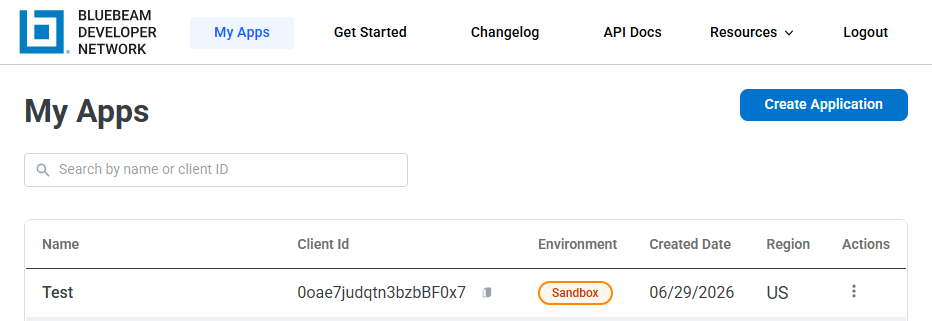
The My Apps table has been updated with additional columns so you can see key app details at a glance.
-
Name: Your created app name
-
Client ID: The unique identifier used in all API requests
-
Environment: The current status (Sandbox, Pending, or Production)
-
Created Date: The date the app was created
-
Region: The API region your app in created in
-
Actions: Select to edit, delete, view credentials, or request Production Approval
At the bottom of the table, view the previous and next pages if managing multiple apps.
Step 5: API documentation & Test Request
Search Endpoints
A new keyword search bar lets you search across all endpoints and parameters without scrolling through the full reference. Type a keyword (e.g., sessions, markups) to jump to the relevant endpoint.
Test Request
Each API endpoint now includes a Test Request button. Select it to open an in-browser panel where you can:
-
Fill in query parameters and request bodies
-
Execute live API calls directly from the docs
-
View the full response inline
-
Switch between coding languages (Python, cURL, and more)
Now available: Markups API endpoints are out of Beta and available to all developers. There is no additional access required.
Step 6: Request Production Approval
Once your app is built and tested in Sandbox, select Request Production Approval on your app's detail page in My Apps. This opens a pre-filed Request Production Approval Form. Once the form is complete, confirm the disclaimer checkbox and click Submit for Production Approval. Finally, Confirm your Submission.
After form submission, the Integrations Partnerships team will email you with a status update within 5 business days.
App status after submission
-
App status changes to Pending once the approval request is submitted.
-
The Integrations Partnerships team will email you with one of the following status updates:
-
PRODUCTION – your app request was approved and promoted to Production
-
PENDING – Bluebeam needs more information before approving your app request and promoting it to Production
-
SANDBOX – your app request was rejected, or you withdrew your submission
-
-
After final approval, your app is promoted to Production. Other users with your client ID and secret will now be able to authenticate through the app.
See also:
Resources
Revu 21
Developer Portal
Developer Portal