Sets panel
Sets allows you to open a collection of documents in a single view with the pages organized in a specified sorted order, including any revisions and addenda. You can navigate through multiple files as though they were one document without actually merging them into a single file. Additionally, files that normally cannot be combined due to PDF security or digital signatures can be viewed as a cohesive collection.
Sets can be opened in read-only mode by an unlimited number of users.
The  Sets panel provides quick access to open, modify, create, print, publish to PDF, and search through Sets. See Working with Sets for more information about many of these functions.
Sets have a few unique navigation properties. See Navigating Sets for more information.
Go to Window > Panels > Sets or press ALT+2 to show the Sets panel.
 Sets panel toolbar

The following actions are available from the Sets panel toolbar:
Sets menu: The following functions are available from the Sets menu:
-
 New Set: Creates a new Set. This is also the default action selected by selecting Modify Set itself. See Creating a Set for more information.
 -
 Open Set: Opens an existing Set. Only one Set can be opened at one time.
 -
 Save Set: Saves the Set that is currently open. If this is an existing Set, it will be overwritten. Sets are saved with the file extension:
 .bex. -
 Save Set As: Saves the Set that is currently open with a new name.
 -
Select All: Selects all pages in the Set that is currently open.
-
Select Latest Revisions: Selects only the latest revisions of the pages in the Set that is currently open. Pages that have no revisions are also selected.
-
Select Previous Revisions: Selects only the previous versions of the pages in the Set that is currently open. Pages that have no revisions are not selected.
-
Publish: Select an option from this menu to publish a Set as a PDF. This can be especially useful when a Set needs to be shared with someone who does not have access to the user's network. There is also an option for exporting a drawing log for the Set. Choose from the following options:
-
Combine: Creates a PDF of the Set. The Combine PDF Files dialog includes options to rearrange the file order, add files, include bookmarks and attachments, merge layers and more.
-
Package: Creates a PDF Package of all the files in the Set without any of the Set ordering.
-
Export Drawing Log: Creates a drawing log of the sheets in the Set.
-
-
 Print Set: Select a print option to print the Set. See Printing a Set for more information.
 Close Set: Select to close the Set that is currently open.
Modify Set: Opens the Set dialog. If no Set is currently open, a Set can be created from here. If a set is currently open, files can be added or removed from here and/or its options can be modified (select Options to access them).
Sets Options:
Sorting
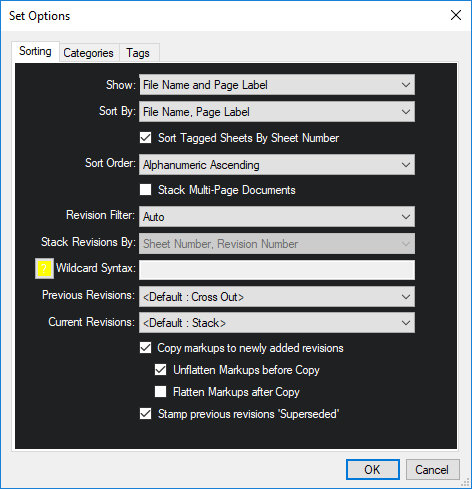
The default values from Sets (Sorting) Preferences are automatically loaded. Changing any of these options will affect this Set only; to make permanent changes that will affect future Sets, change the appropriate preference in Sets (Sorting) Preferences.
Show: Determines what data will be shown to identify documents in a Set. The options are to show file names and page labels or just one or the other, and to show sheet names and sheet numbers or just one or the other.
Sort By: Determines how files are arranged in a Set.
- Page Label Only: Files are sorted by Page Labels only.
- File Name, Page Label: Files are sorted by File Name and Page Label.
- File Name, Page Index: Files are sorted by File Name and Page Index.
Sort Tagged Sheets By Sheet Number: When enabled, tagged sheets are automatically sorted by the sheet number. Only applicable when the Sheet Number tag is in use. Any sheets in the Set that do not have a Sheet Number tag will be sorted by the Sort By selection above.
Sort Order: Determines how pages with alphanumeric page labels will be arranged in a Set.
-
Alphabetic Descending: Sorts pages in descending order based on the first character and then the second character of its alphanumeric page label.
For example, a Set with page labels of 2, 1, 04, 3, 20 would be ordered as 3, 20, 2, 1, 04.
-
Alphabetic Ascending: Sorts pages in ascending order based on the first character and then the second character of its alphanumeric page label (this is the default setting).
For example, a Set with page labels of 2, 1, 04, 3, 20 would be ordered as 04, 1, 2, 20, 3.
-
Alphanumeric Descending: Sorts pages in descending order based on the whole number in the page label.
For example, a Set with page labels of 5.0, 50, 44.1, 40 and 4.1 would be sorted as 50, 44.1, 40, 5.0, 4.1.
-
Alphanumeric Ascending: Sorts pages in ascending order based on the whole number in the page label. Negative and decimal numbers will be at the beginning of the sort, and lettered page labels will appear after the numbered page labels.
For example, a Set with page labels of 5.0, 50, 44.1, 40 and 4.1 would be sorted as 4.1, 5.0, 40, 44.1, 50.
Stack Multi-Page Documents: When enabled, multi-page documents will be automatically stacked by index (ascending). Recommended for long, multi-page documents like spec sheets. Drawing revisions are better served by stacking revisions using the Sheet Number and Revision tags.
Revision Filter: Filters can be applied to a Set if the file naming or page labeling convention supports a revision strategy. Select the type of revision filter to be used. Options include:
- Auto: Revu automatically determines the revision naming strategy by analyzing the file names in the Set and applies appropriate filters. As long as the file naming convention is consistent, this option should work in most cases. See Auto-Matching in Sets for more information.
- Wildcard: Uses the wildcards defined in the Wildcard Filter field (below).
- Off: Turns off the use of revision filters, but saves the current configurations (they just go unused so long as this option is set).
Stack Revisions By: Selections available here are determined by the Sort By selection in the Sets (Sorting) Preferences. If the Set is being sorted by a single field, this option is grayed out. Otherwise, select the field that the Revision Filter (above) will be applied to.
Wildcard Syntax: This field is only available when Revision Filter (above) is set to Wildcard. Enter the desired Wildcard conditions.
Some notes regarding Wildcard syntax
* Represents zero or more characters
# Represents a series of characters that form a number
? Represents a series of alphabetic letters
; Separator for specifying multiple filters
\ Escape character to treat above characters as literal
All other characters are literal
Example: *A# means any characters followed by an 'A' then a number.
Previous Revisions: Select an option to determine how previous revisions of documents will be displayed in this Set.
- Hide: Hides any previous revisions when viewing a Set.
- Gray Out: Grays out any previous revisions.
- Cross Out: Crosses out any previous revisions.
- Show: Shows previous revisions in the Set and the workspace.
Current Revisions: Select an option to determine how revisions will be displayed in this Set.
- Highlight: Places a highlighted border around the outline of the thumbnail.
- Stack: Stacks revisions on top of each other and places a blue arrow on the thumbnail, which can be selected to see the revisions.
Copy markups from Previous to Current: When enabled, Revu copies the unflattened markups from current revisions over to their new revisions.
Unflatten Markups prior to Copy: Unflattens any flattened markups on the current pages before performing the copy.
Flatten Markups after Copy: Flattens markups on the new pages after performing the copy.
Stamp previous revisions 'Superseded': When enabled, Revu applies a "Superseded" stamp to the PDF of previous revisions, informing users who view the PDF—even outside the Set—that a new revision exists.
Categories

The default values from Sets (Categories) Preferences are automatically loaded. Changing any of these options will affect this Set only; to make permanent changes that will affect future Sets, change the appropriate preference in Sets (Categories) Preferences. If sheets have been added to the Set and have already been categorized, changing settings here may cause them to be re-categorized to match the new settings.
Categories: Determines which Sets Category mode to use for this Set. The options are:
- Off: Sets Categories are not used.
- Manual: Sets Categories are used, but sheets added to a Set are not automatically assigned a category. All sheets being added to the Set can be assigned to a category or categories can be assigned one at a time after the sheets have been added.
- Auto: Sets Categories are used and sheets are automatically assigned a category upon being added to the Set.
Categorize By: Indicates what data Revu uses to determine a sheet's category. The options are as follows:
- File Name: The first letter or letters of a sheet's file name are used to determine its category.
- Tag: Drawing Number: The first letter or letters of a sheet's sheet number (as determined by the Drawing Number tag) are used to determine its category. If this option is selected, but the Sheet Number tag is disabled on the Tags tab, all sheets will be Uncategorized.
The categories that are used to sort sheets in the Set are shown in the table and are determined by the template selected previously. They can be modified for this Set by doing any of the following:
- Categories are arranged in the Set according to the sort order found here. Drag and drop to adjust the sort order.
- When a Set is configured to automatically assign Categories to sheets that are added, Revu compares the first letter or letters of the sheet's file name or Sheet Number tag to the values in the Filter column and, if a match is found, assigns the sheet to the corresponding Category. To change a Filter, double-click it and enter the desired value.
Multiple Filters can be assigned to the same Category. Separate multiple filters by a semi-colon (;). Some rules to consider when adding or changing Filters:
- Spaces and other special characters are considered literal characters.
- When a sheet can be sorted into multiple Categories, Revu will automatically choose the strongest match.
- Identical filters are not allowed.
- Categories can be added (
 ) or removed (
 ).
). - Save As saves the configuration as a new template with a name you specify without changing the original template.Revu can be configured to prompt which template to use by enabling Prompt for Template selection in Sets (Options) Preferences.
Tags

Tags preferences set up in Sets (Tags) Preferences will be loaded automatically. Tags can be added or removed, as desired.
To add a new tag
-
Select
. - To add one of the standard tags, select the Default tab and select the desired tag from the menu.
- To add a custom tag, select the Custom tab, then enter the desired Tag Name of the tag and select the appropriate Tag Type.
- Select OK.
To remove a tag
- Select the tag to be removed.
- Select .
To reorder a tag
- Select the tag to be moved.
- Drag and drop it to the desired position in the list.
Some tags (Revision, Discipline, and Sheet Type) can be extrapolated from sheet numbers, if desired. To do so, select any or all of the following options:
- Automatically Tag Revision Number based on Sheet Number: When enabled, the Revision tag automatically extrapolated from the Sheet Number tag. If the drawing's sheet number already exists within the Set, Revu assumes it is the next revision of that sheet. This option is only available when the Sheet Number and Revision Number tags are enabled. If either is not currently included in the list of tags being used, enabling this option adds it automatically.
- Automatically Tag Discipline based on Sheet Number: When enabled, the Discipline tag is automatically extrapolated from the Sheet Number tag. This option is only available when the Sheet Number and Discipline tags are in use. If either is not currently included in the list of tags being used, enabling this option adds it automatically.
- Automatically Tag Sheet Type based on Sheet Number: When enabled, the Sheet Type tag is automatically extrapolated from the Sheet Number tag. This option is only available when the Sheet Number and Sheet Type tags have been added to the Set. If either is not currently included in the list of tags being used, enabling this option adds it automatically.
 Add Files to Set: Adds new files to a Set. See Adding Files to a Set for more information.
 Edit Tags: Opens the Tags dialog to edit current tags, add or remove tags, or reorder tags for the current Set.
 Search Set: Searches all documents included in the Set. The Search tab opens with Current Set selected as the Search In option by default.
 Show/Hide Thumbnails: Toggles between Thumbnail View mode and List View mode. The selection persists until changed.